Monday, February 4, 2019

FFXIV x D&D - Sorcerer Archetype: Black Mage

This is part of a series of posts I'm making in prep for a FFXIV x D&D sourcebook I'm writing. Other related articles are:
Here's a copy of the unfinished product if you want to see it in a coherent form: https://homebrewery.naturalcrit.com/share/S1YXOxGNE

My FFXIV x D&D adventure preparation is well underway. I'll post details about the adventure itself once the players start going through it and I don't need to worry about spoilers. In the meantime, here's another one of my takes on a FFXIV job for D&D play.


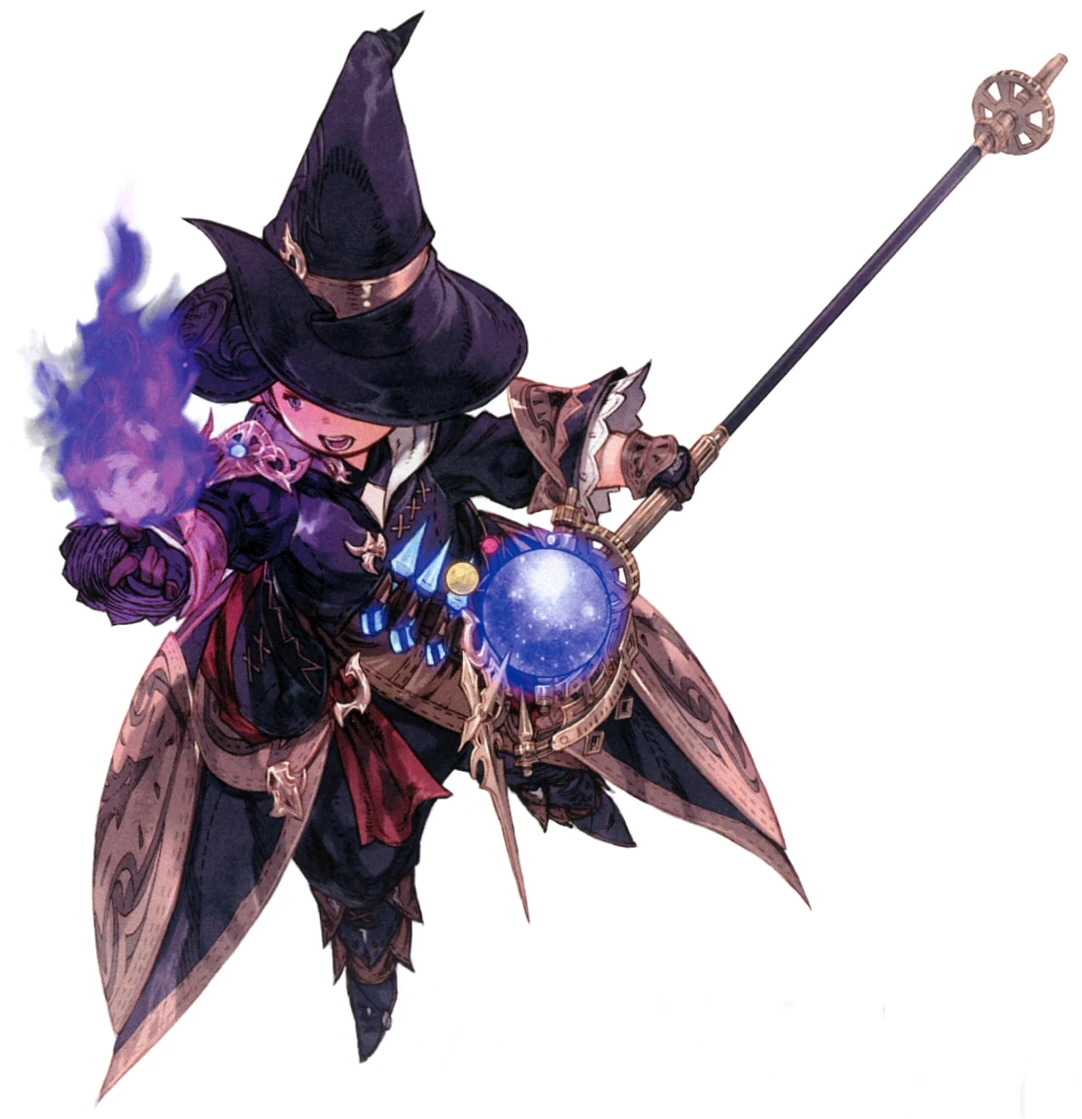
Black Mage
Image result for FFXIV Black Mage


This time, I'm tackling the Black Mage. For this class, I thought it would be better to make a subclass for it instead of a whole new class, since I felt like the FFXIV Black Mage isn't a broad enough of a concept to branch out into multiple subclasses without diluting the essence of the job.

While one would initially think that Wizard would be the correct class to base FFXIV's Black Mage off of, my argument is that Sorcerer is the better choice. Black Mages in XIV don't really base their power off of studies as much as they do from their aether within; We can see this in the Job Quests themselves when the group of Lalafell Thaumaturge sibling mentos have one brother that, as much as he tries to study the arts, just doesn't have the capacity practice the magickal arts. Therefore, we can infer that in order to be a Black Mage, you must be born with a certain aptitude for it; Also it doesn't hurt that the Sorcerer class design, mostly talking about Sorcerer Points and Metamagic here, merges better with the Black Mage playstyle.

Here are some of my thoughts behind the decision process of making these abilities:

  • Manaward and Ley Lines
    • Sorcerer's 1st level abilities mostly settle the tone of what the class is supposed to be, granting minor yet important abilities that set the tone for the subclass. Manaward allows the caster to take more hits than usual. Ley Lines gives them an ability to freely roam within a chosen space that they'll want to stay in throughout a battle.
    • None of these abilities really tell of a Sorcerous Origin by themselves, but it could be argued that they enable their user to tap into their inner potential by allowing them to focus better- and the best way they can do that is by staying still in a battlefield. Knowing this, we can make sense of why a Black Mage would need to learn these abilities first.
  • Enochian
    • This ability then becomes the result of a Black Mage's training coming to fruition. In order to execute this ability, they can't move. Their previous abilities allows them to feasibly pull this off. The main reason for this ability is to give Black Mage's cantrips a bit of a boost without having to increase it necessarily.
  • Aetherial Manipulation
    • In the game, one would normally use this ability to get out of harm's way at the last minute, and this ability reflects that.
  • Polyglot
    • This ability should encompass everything a Black Mage has been working towards into a single, satisfying display of power. The idea was to give them a passive ability that helped them always, and then another ability that they could use to nuke their enemies, at the cost of them losing something. In retrospect, it might feel a little too limiting for the result, but at the time of writing it, I felt it was balanced against other 18th level Sorcerer subclass abilities. We'll see what the future tells!


Overall, I'm pretty happy with how this subclass turned out. I'll probably come back and add some flavor to it so it's not so cold and crunchy. I'm pretty sure I can word some things a lot better, too. Next up, I'll be working on the Warrior.


Saturday, January 26, 2019

FFXIV x D&D - Monk Archtype: Way of Rhalgr


This is part of a series of posts I'm making in prep for a FFXIV x D&D sourcebook I'm writing. Other related articles are:
I've finally convinced my FFXIV buddies to play D&D. The idea pitch that worked is for us to play a D&D game using our own XIV characters. I already knew of the existence of a homebrew version of the classes (found here) so I thought that transitioning one from the other might be easier.

I started looking at this homebrew stuff in more depth and it turned out that I wasn't entirely convinced about the end result; With all due respect to the man who put it all together, it must have been a massive undertaking to do so. The following is just my take based on his work, of which I am completely grateful for.

Keep in mind, none of this belongs to me or this person.


Here's a copy of the unfinished product if you want to see it in a coherent form: https://homebrewery.naturalcrit.com/share/BJrIkCw5QE


Way of Rhalgr

I'm starting with this Monk subclass because I thought it was short enough to get started quickly. It turned out that I wanted to make more changes than I anticipated. Let's have a look. I wrote the text description of the abilities in italic and blue.


Greased Lightning

Beginning at 3rd level, you are able to launch attacks at an incredible rate. If you use flurry of blows and successfully attack your target with both of the unarmed attacks, you may make an attack roll for one more unarmed attack with double the proficiency bonus.


I see two issues with this ability:

  1. The wording behind "succesfully attack" is a bit confusing. Does it mean that you need to hit with both of your flurry of blow attacks? Or is it enough to just make the attacks?
  2. If we look at every other level 3 Monk ability, none of them allow you to deal more damage, and instead you're offered more things to do with your flurry of blows, or even different ways to attack an opponent.

This ability, as presented, does bring out the spirit behind Greased Lightning to being, but the issue is that it kind of doesn't work along the rest of D&D 5e's design. Also, while I like the idea of putting in a prerequisite to be able to execute something, I think having to hit with both of your flurry of blows attack to trigger a fundamental ability could get frustrating if the dice isn't in your favor. So what do we do?

Why don't we implement "positionals" instead? Not in a literal sense, of course. Perhaps the Monk has to move at least 5 feet every turn in order to get their Greased Lightning bonus; It would certainly give them the feel that they have to position themselves in a different place each turn. Opportunity Attacks in this edition are now only triggered when leaving your opponents' threat range, so it's feasible to do expect players to perform maneuvers like this.

As for the benefit of Greased Lightning, I would grant advantage on Flurry of Blows attacks; This way it's like they're using the momentum of their movement to perform faster attacks, giving them advantage. It's something they'll be able to use a lot more often. It loses a bit of that combo feel, but maybe we can get that in one of the later features.


Touch of the Elements

Beginning at the 6th level, you have learned a variety of elemental attunements which dictate your day. When you complete a long rest you may select one of the following boons. You receive the benefits of that element until you next complete a short rest. You may only change your selected benefit after a short rest.

Hands of Earth. You gain proficiency in your wisdom ability checks which you do not already have proficiency in. You may change the damage of your unarmed strikes to poison. You may use 1 Ki point to use the shove action as a bonus action.


Hands of Wind. You gain proficiency in your dexterity ability checks which you do not already have proficiency in. You may change the damage of your unarmed strikes to lightning. You may use 1 Ki point to use the Disengage or Dash action as a bonus action.


Hands of Fire. You gain proficiency in your strength ability checks which you do not already have proficiency in. You may change the damage of your unarmed strikes to fire. You may use 1 Ki point to deal additional fire damage equal to your Wisdom modifier each time you land an unarmed strike.


  • While the general idea gets across, the wording used to describe this ability can become problematic at the table. What if I take a short rest, which ends my stance, and forget to announce that I keep or change the stance? Also, forcing players to change this only at short rests kind of takes away from the fun of changing stances in the middle of a fight, and I wonder if we can somehow implement that instead.
  • Hands of Earth: 
    • Handing out proficiency to ability checks like this is like handing out interchangeable skill bonuses. If you plan your initial skill selection around this ability then you're basically able to roll almost any skill that isn't INT based with proficiency; I understand the idea behind this ability, but it shouldn't turn monk into a limited bard or rogue.
    • Monks get Ki-Empowered Strikes at this same level, so there's no real need for them to deal elemental based damage.
    • Allowing the use of a Ki point to shove opponents as a bonus action is a cool idea.
    • Looking at other monk abilities of the same level, it's a little too powerful to grant them three separate abilities instead of the usual one or two.
  • Hands of Wind:
    • This has the same issues as Hands of Earth in regards to ability checks and elemental based damage.
    • Monks gain Step of the Wind at 2nd level, which not only allows them to use the Disengage and Dash actions as bonus actions at the cost of 1 Ki point, their jump distance is also doubled for that turn.
  • Hands of Fire:
    • This has the same issues as Hands of Earth in regards to ability checks and elemental based damage. Also, while granting a damage bonus is on par with the idea behind Fists of Fire, I think I prefer a die roll than a straight modifier bonus; we can make this fire damage to balance it out, since some creatures are resistant or immune to it.

Now here's how I'd handle this ability:

First of all, I'd change the wording so that it's easier to change boons, and I'd call them stances. I'd make it so that you can change them during the middle of a fight as well. Hands of Earth and Hands of Fire are easy enough to adjust; Hands of Wind needs a big rework since the idea behind it is to make the character faster, which is something that the D&D Monk class already does in spades.


Beginning at 6th level, you have learned a variety of elemental attunements for which you developed a fighting stance. Once you're in a stance, it's benefits last until the end of your next short  or long rest. Once you change stances, you must take the benefits of the new stance. You cannot benefit from two stances at the same time. Each stance benefit is as follows:
  • Hands of Earth. 
    • You can enter this stance as a reaction if you are being forced to roll a saving throw. While you are in this stance, whenever you make a Strength, Dexterity, or Constitution saving throw, you can spend 2 Ki Points to make a second roll. You can choose to spend your Ki Points after you roll the die, but before the outcome is determined. Once you make a second roll, you must use the new result.
  • Hands of Wind. 
    • You can enter this stance before you use your Step of the Wind feature. While in this stance, you don't need to spend a Ki Point to gain the effect of Step of the Wind. 
  • Hands of Fire. 
    • You can enter this stance as a bonus action if you spend 2 Ki Points. While you are in this stance, when you hit a target with an unarmed strike, you can to cause your attack to deal an extra 1d4 points of fire damage to the target. 

I'm not entirely convinced with how Hands of Earth turned out, but I'll leave it like this for now.

Forbidden Chakra

Beginning the 11th level, you have gained a significant understanding of the Fist of Rhalgr style. After connecting with a successful Greased Lightning strike, you may spend 2 Ki points to deliver a powerful blow. The targeted creatures make the appropriate saving throw against your Ki save DC.

Dragon Kick. A leaping corkscrew kick aimed at the target's head, dealing 2d8 bludgeoning damage. The target must make a constitution saving throw, on a failed save, your attacks have advantage against that target for a number of rounds equal to your Wisdom modifier.


Elixir Field. You leap into the air where you stand and unleash a wave of Ki energy downwards, suspending yourself in the air as you burn all creatures within a 10ft. radius centered on you. Affected creatures make a dexterity saving throw, receiving 4d8 radiant damage on a failed save and half as much on a successful save.


Howling Fist. You crash your fist into the ground with tremendous force, causing a shockwave of Ki powered explosions to travel in a 15ft. line in front of you. Affected creatures make a dexterity saving throw, receiving 4d8 fire damage on a failed save and half as much on a successful save.


Tornado Kick. You leap into the air and deliever a series of swift but powerful kicks to your target creating a small localized tempest. The creature makes a strength saving throw receiving 4d8 bludgeoning damage on a failed save and are knocked back 10ft, and half as much on a successful save, with no knockback.


First of all, I kind of broke this ability back when I changed Greased Lightning, but it's an easy fix; just allow a Forbidden Chakra move to be used after you hit with one of your Flurry of Blows attacks once on each of your turns. Second, I feel like there are way too many options in this ability, but I would leave this as is for now. The abilities themselves are okay, though I'd make some minor alterations to them just so they fit with D&D 5e's design better.


Perfect Balance

Beginning at the 17th level you may activate Perfect Balance as a bonus action. You can use any of the abilities offered by the Forbidden Chakra feature at any time at the cost of 6 Ki points. You may only do this once per long rest.

The wording in this is a little confusing to me. What does "at any time" mean? Does it mean that you don't need to connect a Greased Lightning attack? Does that mean it's a free action to use? Does the 6 Ki Point cost cover the 2 Ki points needed to activate a Forbidden Chakra ability? When does this ability end it's effect? I also take a bit of issue that it's so costly.

At 17th level, your training in the . You can activate a Forbidden Chakra ability after you hit with any unarmed strike you make once per turn. This ability does not replace your normal use of Forbidden Chakra, and you can still use a Forbidden Chakra ability after you hit with an unarmed stike during your Flurry of Blows on each of your turns.


Conclusion

I'm not entirely satisfied with the end result; As I kept looking into it, it turns out that the base D&D class already has a fire / earth / wind mechanic with Flurry of Blows / Patient Defense / Steps of Wind , and adding it the way we are is a bit redundant, if not forced. In a future iteration, I hope to break the Forbidden Chakra feature in two and play with the interaction between Greased Lightning and other features better.

I'm gonna keep going over the rest of the classes as I gain inspiration, going from just subclasses and races to later on, full classes. In the end I hope to this all leads to a fun game I can provide for my friends.
Monday, January 14, 2019

TOMB OF ANNIHILATION: Grung Playable Race


One of my players came up to me and asked if they could play a Grung character. After I investigated, I noticed that there's no official release for a playable version of this race, and instead there's a list of deduced stats taken from an article. I wasn't entirely satisfied with the result and decided to put my own spin on it.

Links involved:
https://1d4chan.org/wiki/Grung
https://www.sageadvice.eu/2017/09/05/grung-as-an-official-playable-race/
https://www.dmsguild.com/m/product/223738


Link of my final product: https://homebrewery.naturalcrit.com/share/BkXEjZjtfE


Here's the stuff that I changed. I wrote the things that were extrapolated in red, and my changes to them in green. Finally, I explain my changes in italics.

Ability Score Increase: Your Dexterity score increases by 2 and your Constitution score increases by 1.
Ability Score Increase: Your Constitution score increases by 2 and your Dexterity score increases by 1.

It's easy to give a small race a +2 bonus on dexterity, and though it would have fit for Grungs, there's something we need to consider. Their immunity to poison, as well as the fact that they live in a place where it's easy for them to dehydrate, should give the idea that they are naturally more hardy. The Grung monster stat block supports this by giving them a higher constitution score than they have dexterity.


Arboreal Alertness: You have proficiency in the Perception skill.
Arboreal Mobility: You have proficiency in the Athletics skill.

Though giving them Perception proficiency would fit, we should consider that Grungs are meant to be more athletic than they appear. Their Standing Leap ability shows this. If you check the Grung's stat block, they have a +2 bonus for both Athletics and Perception, but their natural Strength of 7, compared with their Dexterity of 14, makes me believe that their natural bonus to Athletics was made to help them with their weakness. 


Poisonous Skin: Any creature that grapples you or otherwise comes into direct contact with your skin must succeed on a DC 12 Constitution saving throw or become poisoned for 1 minute. A poisoned creature no longer in direct contact with you can repeat the saving throw at the end of each of its turns, ending the effect on itself on a success. You can also apply this poison to any piercing weapon as part of an attack with that weapon, though when you hit the poison reacts differently. The target must succeed on a DC 12 Constitution saving throw or take 2d4 poison damage.
Poisonous Skin: On your turn as a bonus action, you can choose to secrete poison. When you do so, you can choose to coat one slashing or piercing weapon or up to three piece of ammunition. Once applied, this poison retains potency for one minute before drying, or when you make an attack with the coated weapon or piece of ammunition. Alternatively, you can spray the poison as a bonus action on a single creature that is in contact with your skin. 

A creature that makes contact with the poison must make a Constitution saving throw, the DC of which is 8 + your proficiency bonus + you constitution modifier. The creature takes 2d4 poison damage and is poisoned for 1 minute on a failed save, and takes half damage without being poisoned on a successful one. A creature that was poisoned by this effect can repeat the saving throw at the end of each of its turns. After you use this ability, you can't use it again until you complete your next short or long rest.

This ability had three issues:


  1. It's not party friendly: This would make it difficult for fellow party members to heal or carry their Grung teammate.
  2. The poison DC is set: Most, if not all, racial features that force a saving throw have a DC that adjusts to their proficiency bonus and one of their stats. A set DC just gets weaker as a character progresses.
  3. It's always on: Racial Features are usually limited in a short rest or long rest basis. This one would have the Grung PC be able to add poison to all their attacks, forever.


I turned this feature into an attack that was not only simple to use, but would also be a staple for a melee Grung combatant. Adjusting the DC and turning it into a short/long rest ability helped balance it. I'm not entirely happy that the end result turned into a longer paragraph so this might be something I could look into adjusting in the future. 

Water Dependency: If you fail to immerse yourself in water for at least 1 hour during a day, you suffer one level of exhaustion at the end of that day. You can only recover from this exhaustion through magic or by immersing yourself in water for at least 1 hour.
Water Dependency: If you don't immerse yourself in water for at least 1 hour, you need to drink twice the amount of gallons of water required to stay hydrated at the end of the day.

We already have an end-of-the-day system that penalizes you if you're not taking care of yourself. Not only would the original version have worked on top of something that already exists, it would have made itself really annoying to play. 

Also, consider this; the wording implies that a Grung with no access to water would risk receiving two levels of exhaustion at a time. One from the normal dehydration rules, and another from their own racial features. Not just that, but their racial feature also doesn't grant a Constitution saving throw to save themselves.

What I did was add an extra condition to the system that already works. They just need more water than any of the other races, but they are penalized the same if they don't meet the requirements.

I'll probably come back to this as I continue playtesting it.


Monday, September 3, 2018

#RPGaDAY2018 - Day 27: Share a great stream / actual play


I've been looking at several actual play streams lately, searching for a group that I'd enjoy watching weekly. Among the couple of groups I went through, the one I'm liking the most at the moment is Critical Role.


Image result for critical role
The production value of this show really helps


That being said, there is one actual play stream in particular that I would recommend everyone to watch, and it's not related to the Critical Role show. I'm talking about an episode of Acquisition Incorporated, a game where the guys at Penny Arcade get together during each PAX and play in front of a live audience.


This game has unicorns, dragons, giants, airships, and floating castles in it


This stream is the most fun I've had watching actual play. Not only are the players on the table genuinely funny, Chris Perkins is a master DM, and he killed it in this game. If you have four hours of free time, I would suggest letting this play out in the background (although you will want to watch the last hour or two).


#RPGaDAY2018 - Day 26: Gaming ambition for the next 12 months


For the next 12 months, I foresee myself running Tomb of Annihilation until that campaign is over. In the meantime, I also look forward to playing in my friends' games. If I'm lucky, I'll be able to run a game or two for some other friends that have never played before.


Related image
Waterdeep: Dragon Heist is almost out, so perhaps I can put it to good use!


Perhaps within that time, I'll tackle my interest of streaming a game of D&D. I've wanted to do something like that for several years.

I've also always wanted to write, and perhaps publish, my own content. I'd say this event has motivated me a little, and from now on, I will try to write something on this blog about once per week. There's a couple of ideas that have surfaced in my head lately and I'd like to materialize them. Perhaps after I post enough, I can look for a way to publish it. Baby steps.


#RPGaDAY2018 - Day 25: Preparing for an extended campaign. Part 5 - Ongoing Preparations


This post concludes my five part answer of how I prepare for an extended campaign.

Part 1: The Goal and The Antagonist

Part 2: Notable Landmarks

Part 3: Player Integration

Part 4: Adventure Outline


Part 5: Ongoing Preparations


Preparation doesn't end when the campaign begins. Before and after every session, I take some time to go through what's happened so far, what the PCs actions were and how they impacted the world and the story. Did they like a certain NPC? Is there anything I should bring more (or less) of? I try to fine tune my campaign every session to ensure that it stays fresh and everyone stays engaged. 

I'll end this one on a short note, since there's many great guides out there that detail ways to prepare yourself for your gaming sessions (and I don't want to give away all my secrets yet), and also because I'm past due RPGaDay and there are many projects I'd like to work on. Perhaps I can cover this subject in better detail at a later time. 


Image result for strahds coach

#RPGaDAY2018 - Day 24: Preparing for an extended campaign. Part 4 - Adventure Outline


This post resumes my five part answer of how I prepare for an extended campaign.


Part 1: The Goal and The Antagonist

Part 2: Notable Landmarks

Part 3: Player Integration

Part 5: Ongoing Preparations

Part 4: Adventure Outline

Once you have a good idea of the game's key points and how they connect to the players, it helps to write down a general idea of how you think the story could go. Keep in mind that this is bound to change at any time based on player decisions or any events that could change circumstances, so don't get too married to the idea of your original outline. If there is a better story to be told, go with that story instead.


WARNING: MAJOR CURSE OF STRAHD SPOILERS


The adventurers begin the adventure by entering Strahd's realm and the village of Barovia. This place needs to give the PCs enough of a shock for them to understand that they're not in Kansas anymore and how different it is from their home. Everything is bleak, Strahd does what he wants, and nobody can stop him. The NPCs here will suggest the PCs go talk to Madam Eva, who gives the PCs a card reading, which is basically a plot hook for at least three different places.

When the players reach Vallaki, they should be given the hook that the Wizard of Wines has not delivered wine lately and therefore they should check it out. Vallaki is also a good way to show how twisted the realm becomes in Strahd's influence. There are many ways for the PCs to gain allies here, so they know that they're not the only ones trying to fight back.

Eventually, the PC's path will lead to the Wizard of Wines, where they learn about the druids. From there, they'll head to Yester Hill. Following my notes from the previous posts, if a PC is tied to the archdruid, they may have a difficult decision to make. If they find Strahd here or otherwise find an NPC to expose Barovia's past, this can be a good midpoint to the story where the players start to find out what makes Strahd tick, by learning about his ancestral home. 

With some wine in tow, the PCs are able to enter Krezk and meet the Abbot. Even if there isn't a PC tied to the Abbot, the player will face a difficult decision on whether to play along with the twisted celestial or not. Regardless of the outcome, it'll make for good roleplaying. Krezk also serves as a way to further learn about Strahd if the players manage to bring Ireena here.

By now, the PCs may have explored enough of Barovia to feel confident enough to tackle Castle Ravenloft. Before that, however, they may want to check the Amber Temple first. In my game, the PC that was tied to Kasimir would have had an idea of how to reach the temple, and was just waiting for the best time to suggest going in. Since Kasimir's goal involves grabbing a dark power from the temple in order to use it inside Strahd's castle afterwards, he would have more reason to enter the temple first. By the end of Amber Temple, the PCs should know enough about Strahd to understand his origins and motivations. 

When the PCs enter Castle Ravenloft, Strahd expects them. The PCs are there to take down Strahd once and for all, but for the Vampire, they are all his playthings for the night. As they explore the castle, they learn of Strahd's depravity, and by the time they fight, they should be made well aware of his reign of terror, enough for their victory against him to be satisfying.

Image result for castle ravenloft
Strahd waiting for the PCs to show him a good time

There are many other places that this adventure can go to, of course, and this is just one path that you could take your players through in order to tell the story you want. The players shouldn't feel forced to go down any given path, and they may make a detour or two, but if you place the right incentives and motivations at the right places, it'll be easier for you to lead them to the story you want to tell.


Worldbuilding: Myths of Draconiquity, Part I - The Goblin King

  The Goblin King Myths of Draconiquity, Part I The origins of the archfey known as The Goblin King usually refer to his time as an old mage...